AetherCFD Studio
Prototype softwareA Windows desktop workbench that drives OpenFOAM in WSL without hiding it. Every action maps to real dictionary files and real commands, edited losslessly, and every change goes into a revertable command journal. It adds mesh-quality tools, Cantera-based combustion pre-calculations, GPU visualization and data-driven analysis. An AI copilot can act only through steps that the user approves.
WhatA GUI that keeps the files honest
Most CFD front ends trade transparency for convenience, and the case ends up hidden inside the GUI. AetherCFD takes the opposite position:
- The headless core never imports Qt.
- Every form edits the real OpenFOAM dictionary with a lossless round trip.
- Every action can be replayed as the exact command it ran.
A user can open the raw files at any point and nothing is lost. That is the whole point.
HowWhat is in the workbench
- Setup: a template-to-case wizard, numerics checks with journaled fixes, and a raw / form / split dictionary editor.
- Meshing: checkMesh-exact quality hotspots shown in 3-D, a blockMesh grading designer, an O-grid hole-blocking tool, y⁺ layer sizing and CAD intake.
- Combustion advisor: Cantera pre-calculations of stoichiometric mixture fraction, adiabatic flame temperature, flame speed and combustion regime. The results go into EDC, PaSR or flamelet dictionaries.
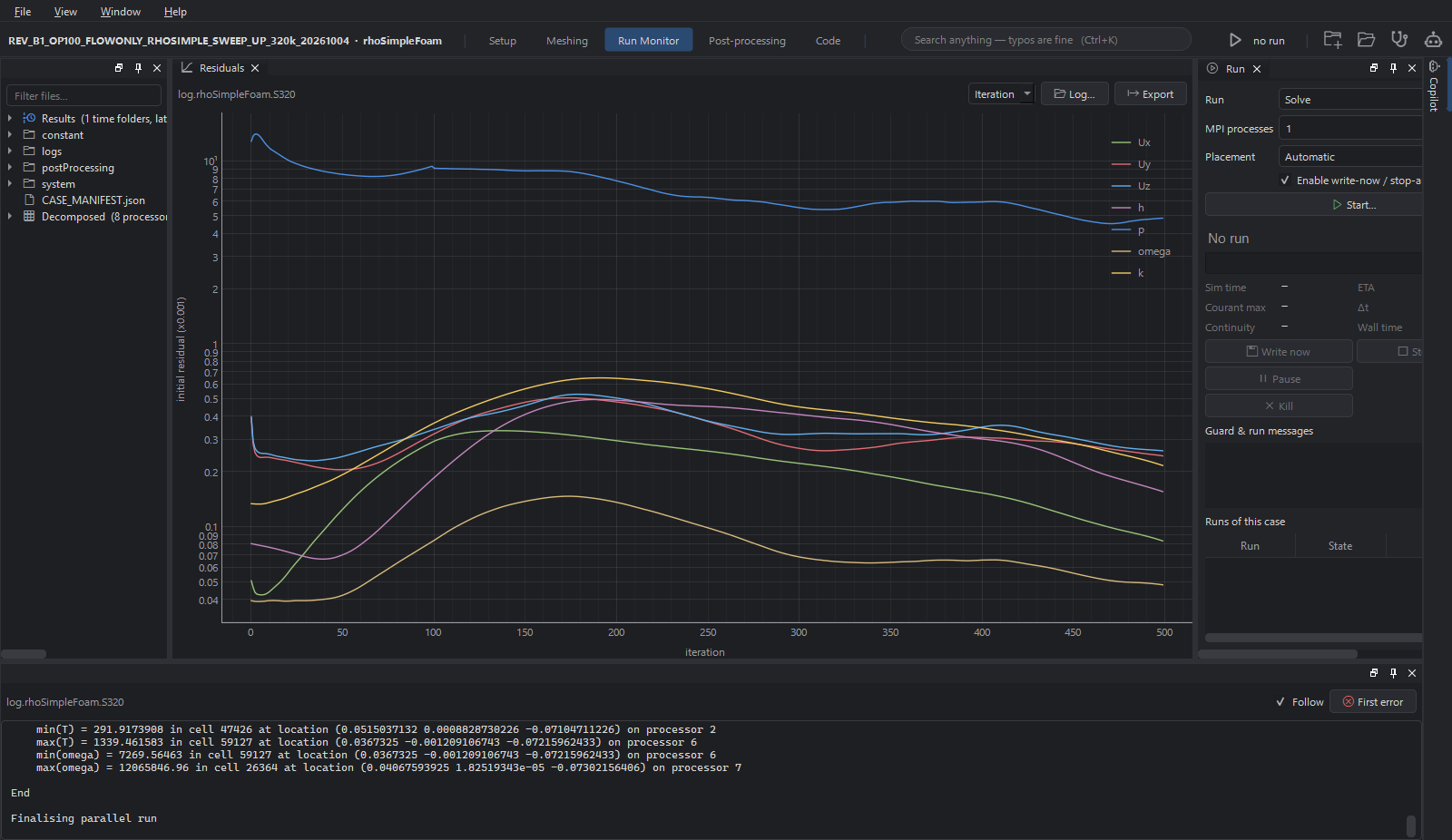
- Run control: plan-first execution, with guards against runaway logs, disk and memory.
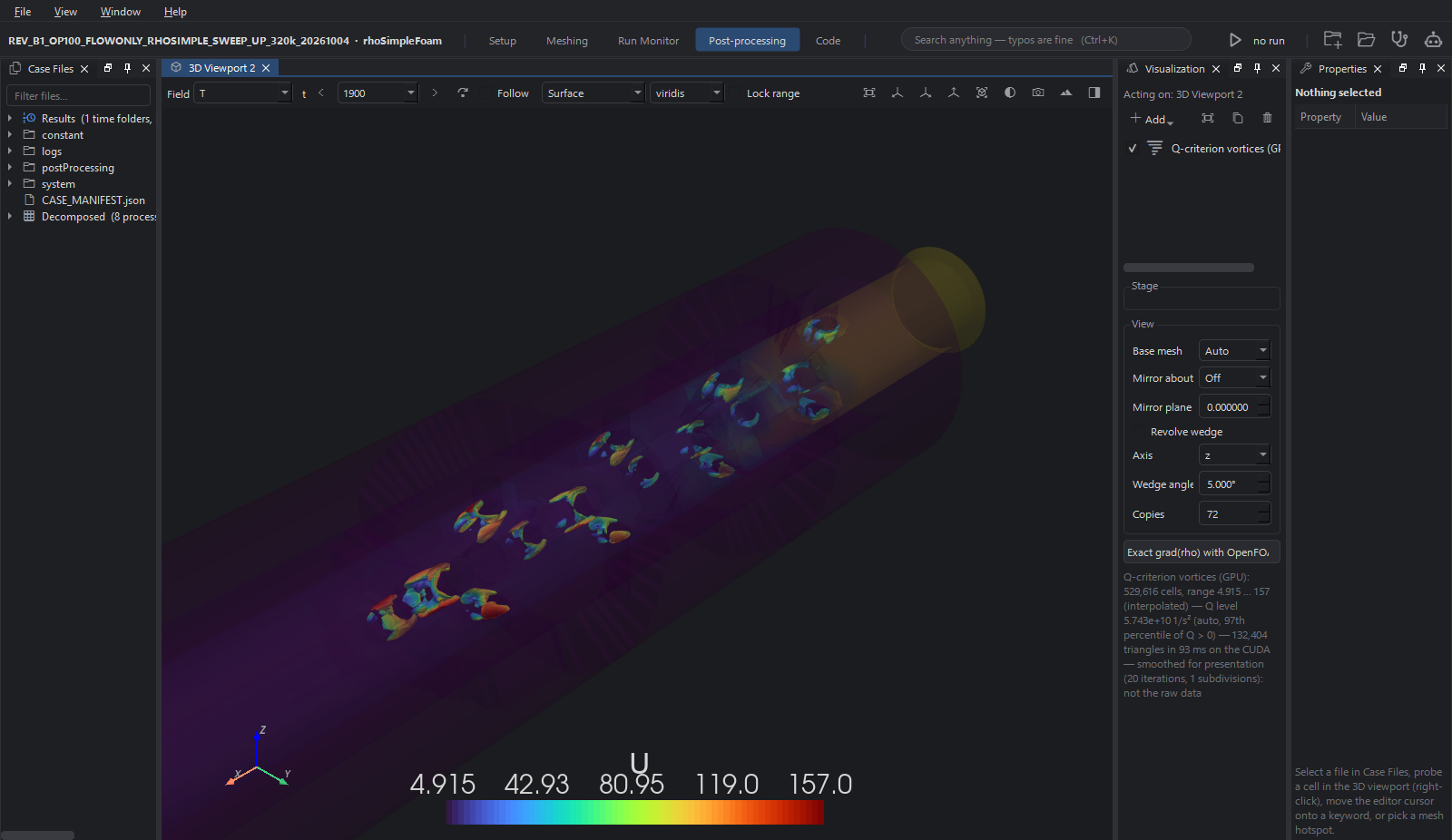
- Post-processing: GPU Q-criterion, slices, streamlines, exact density-gradient (numerical schlieren) images, and 8K or ray-traced renders.
- Analysis: POD/DMD, Gaussian-process surrogates, physics-informed neural networks and optimal-interpolation data assimilation.
AetherCFD runs on the same laptop as my simulations (see the Sandia Flame D page). With limited hardware, a runaway case costs real time. That is part of why the run control guards execution so carefully.
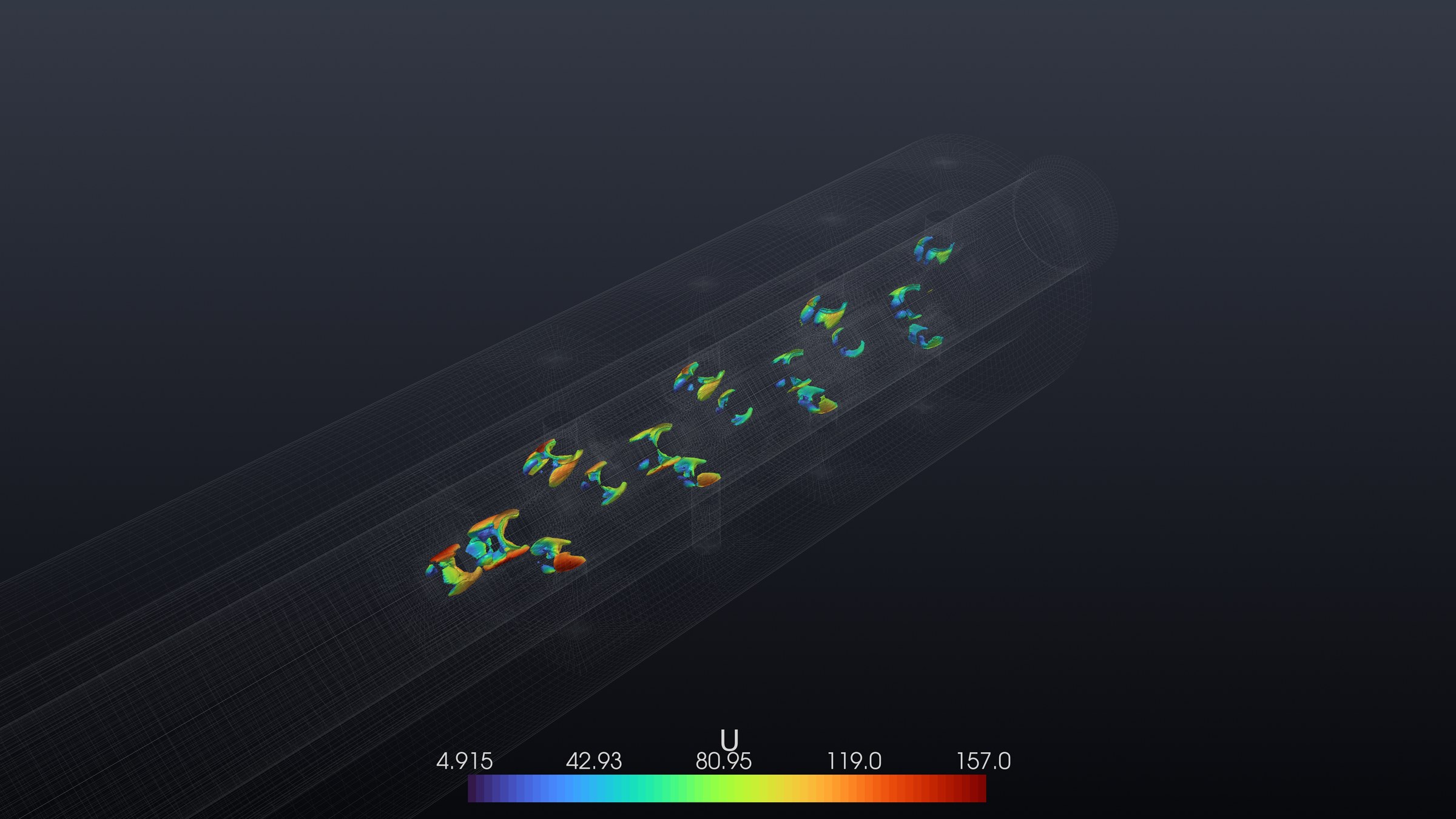
Vortex identification uses the second invariant of the velocity gradient. The workbench extracts the vortex surfaces on the GPU with marching tetrahedra. On a 529,616-cell case, it produced 132,404 triangles in 93 ms.
Regions with \(Q>0\), where rotation dominates strain, are drawn as vortex surfaces.
The copilot (Claude or Codex) can read every file and log and propose changes. But each change shows as an exact plan to approve, and the command journal records it. This is the same rule as in the CFD Agents framework that AetherCFD is built on.
ResultsCase study: making the probe mesh solvable
The first mesh of the probe B.1 dilution holes (733,824 cells) had three problems:
- a maximum non-orthogonality of 69.6°
- aspect ratios up to 72.5
- a 9:1 jump in cell volume.
The steady solve diverged at iteration 558. Re-blocking the holes with the O-grid tool gave a 1,028,736-cell mesh that is better on every metric.
| Metric | First mesh | O-grid hole blocking |
|---|---|---|
| Cells | 733,824 | 1,028,736 |
| Max non-orthogonality | 69.6° | 64.7° |
| Faces above 65° | 3,456 | 0 |
| Max aspect ratio | 72.5 | 19.2 |
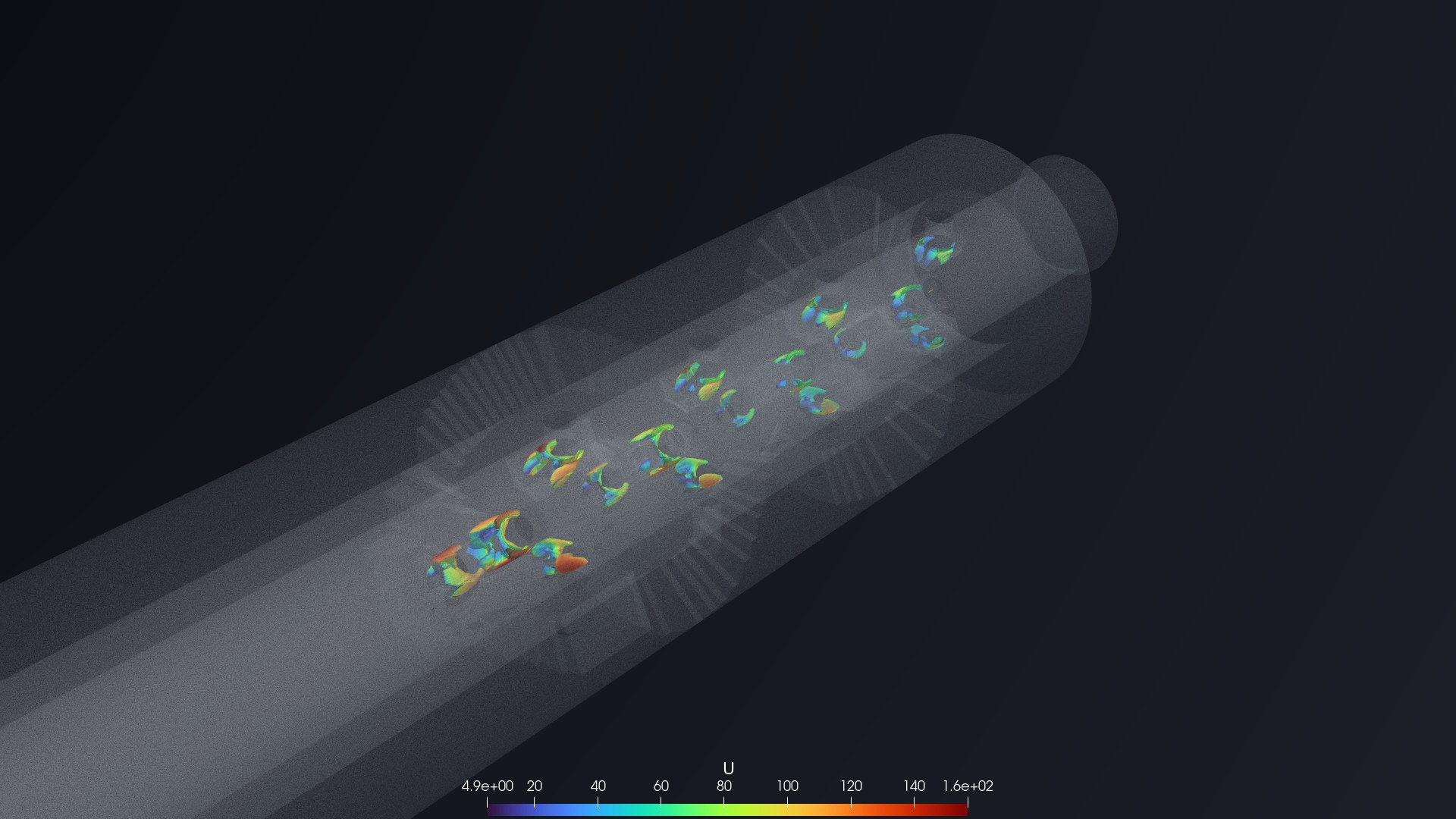
The better mesh quality makes the case easier to solve. It does not show that the computed probe flow is correct. The renders are visualizations of that CFD solution, and they are not compared with measurements.
The physics-informed network for field reconstruction reproduces the analytical Kovasznay flow to 0.06–0.4%. That is an analytical demonstration on a known flow.
AetherCFD is a version 0.1 prototype. The guided workflow and grid-convergence tools are not in its main version.